Updated 12/30,2025 – This article is continually under development, a bit of thinking in words, and represents a discussion I’m having (with myself) and a research placeholder. I do not host any references and provide links to primary sources. If a link below is broken, please let me know, and I will update it if the source is still available. See the reference section for documentation referenced in this discussion.
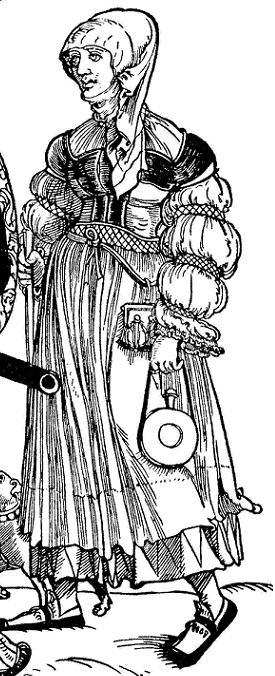
In 2020, I finished an overly complicated and probably inaccurate early 16th-century shirt (hemd) loosely based on the woodcut Tailor and Seamstress by Erhard Schon, 1525-1530, from Landsknecht Woodcuts: Kriegsvolker im Zeitalter der Landsknechte (Johann, A. G., Enkevoerth, B., & Falke, J. v., editor M. McNealy, 2013). In my project, I interpreted the diamond shapes seen in the early 16th-century German shirts and aprons with honeycomb smocking. See my how-to on honeycomb smocking for an explanation of how it is done.
As I was finishing my documentation for an SCA A&S competition, I had the opportunity to meet with Marion McNealy and SCA Viscountess Rowan Perigrynne (through a Patreon membership) to discuss research and fashion in the early 16th century. German Lands. The question arose, “Was it honeycomb smocking in the hemden (shirts) and schürzen (aprons)”? Rowan shared with me an example of a halbschürze (half apron) with tight, shallow pleating and a trellis-top-stitch diamond pattern that aligns well with woodcuts and paintings (https://rowantreeworkshop.com.au/16thc-halbschurze-apron/2019/). It inspired a shirt (hemd) project.


What is surface embroidered or top stitch or pattern darned pleat-work? This is where a shirt or apron is tightly pleated, and then an embroidery pattern is stitched on the surface or top of the pleats.
For pattern darning, the shirt or apron is also tightly pleated, and a pattern is woven onto the top by alternating the top of the pleat to the middle or back of the pleats. There are excellent examples of historical pattern darning on Lee Ann Posavad’s blog, Medieval Handywork, and how-tos for these techniques with more details in Fitzarbeit Buchlein – The Pleatwork Book and on Thimble and Plumes Youtube channel.
Counted thread shirring is a pleating technique in which pleats are formed by multiple rows of gathering thread. The gathering threads remain in the finished section; there may or may not be topstitching. I have recently discovered some examples of Italian, Sardinian, Belarusian, Romanian, and Ukrainian traditional dress with counted thread shirring on the webs, and started to think of shirring as a likely technique used in some German shirts and aprons from the 16th century (I’m sure someone has likely already figured this out, I just stumbled across it recently and I’m very excited! Indeed Thimble and Plume mentions it as a style seen in 16th c. hemden) and mention of Italian shirring shows up in literature on 16th c. clothing. The US English version of “Shirring” does not fully capture the style I’m referring to. I hope to have some names for it in other languages soon to capture it fully. There is some fantastic work people have up on Pinterest and Facebook, particularly the “puntu vanu ricamo sardo” board belonging to Patricia Pela’ on Pinterest and Polonets Olga’s soulful handmade. I’ve created a gallery on Pinterest of some of the extraordinary works I’ve run across. In The First Book of Fashion, Matthaüs is described as wearing a pleated shirt that could be “Italian Shirring” (Rublack, Hayward, & Tiramani, 2015, pp. 295). Additionally, the shirt example photographed and described by Jenny Tiramani from the 1550s at the Church of San Domenico Maggiore in Naples has a chevron shirred pattern (Rublack, Hayward, & Tiramani, 2015). The pattern below, by Polonets Olga soulful handmade, stands out to me in particular as a possible culprit for how that pattern was achieved in some images of shirt collars. See my page https://annevonwiese.com/2022/07/31/folk-shirring-puntu-vanu/ for more information. I have not seen anyone apply it to 16th-century recreation projects. I made a 16th-century German Men’s Shirt with a Shirred Pleatwork Collar for an SCA A&S project informed by this research.
There is extensive imagery of shirts and aprons with diamond patterns along the edges, collars, and sleeves in early 16th-century German Lands. These images include paintings, carvings, woodcuts, and drawings.
Tangent warning – The examples of ladies’ shirts, maybe half shirts or partlets, not full shirts, mainly if very fine linen is being used. This is a whole other conversation… See Textiler Hausrat: Kleidung und Haustextilien in Nürnberg von 1500–1650 (Zander-Seidel, 1990). A vital point Marion McNealy emphasized is the need to consider fabric cost and class relative to the rigors of washing something that comes into contact with the body (pers. comm., Sept. 2021). Also see textile finds, fabric descriptions from Lengberg Castle (Nutz & Stadler, 2012), and the fabric discussion in Drei Schnittbücher: Three Austrian Master Tailor Books of the 16th Century (Barich & McNealy, 2015).
I am aware of only one extant example of honeycomb smocking in a shirt: a boy’s shirt from Alpirsbach Abbey in Alpirsbach, Baden-Württemberg, Germany, dating to the second half of the 16th century. The smocking is inside a shirt sleeve cuff, which creates a narrowing like elastic (Fingerlin, 2001, p. 753) (see below). It is not visible on the outside of the sleeve, and the method is not the same as the technique in which threads run along the other side of the pleat to travel to the next row. Additionally, it occurs slightly later than the peak of the popularity of the diamond-embroidered styles seen in the German Lands (1500-1535). However, this example demonstrates a smocking technique similar to modern honeycomb smocking that was in use at the time, and it was used on shirts to shape them around this time. Is it possible that it was more widely used in clothing and that there are simply no extant survivors? Shirts, smocks, and clothing were used, reused, and recycled into materials such as rags and paper. Check out – https://www.kloster-alpirsbach.de/en/interesting-amusing/collection/clothing-from-alpirsbach-monastery#img-pagewide-3
Although it is not a shirt…. This bag from around 1650 from Sweden in a lovely green velvet is very much so surface honeycombed smocked…
The Royal Armoury –Livrustkammaren museum in the Royal Palace in Stockholm, Sweden.
There is an example of embroidery on pleats in an extant garment at the Museum of London. From the available pictures and info, it’s unclear whether it is a top-stitch or a darned pattern; it’s probably darned. It is suggested to be a wool cuff found at an archaeological site on Worship Street, Finsbury, London (1500-1599). Although it is not a German example, the pattern closely resembles those found in German Modelbücher 1524-1556: a compilation of eight German needlework and weaving pattern books (McNealy, 2018), and its visual style is similar to much of the imagery of the time.
Modern pleating machines replicate these pleats well. A pleating machine consists of cranks with needles and creates pleats 1/8–1/6 inch deep. Although there is no clear evidence of how it was done in the 16th century, some suggest that an unknown pleating tool yet to be discovered by researchers may have been used (McNealy pers. com., July 2021). I agree with this line of thinking. Visually pleating machines produce pleats that closely resemble those seen in paintings and other images.


The woodcuts and drawings, in particular, tend to look similar to a modern honeycomb smocking on initial evaluation. Many creators have interpreted the pattern as honeycomb smocking and created 16th c. German shirts and aprons in this manner, including myself. In my discussions with researchers, the topic of the “community” shaping accepted styles in reenactment comes up frequently. Marion McNealy pointed out that, early on, before the internet, people recreating Landsknecht garb for reenactment often relied on photocopies of woodcuts, which lack detail (pers. com., September 2021).
Looking back at my own work before I became involved with an organized reenactment community, I made a lot of garb with backstitch/topstitch pleatwork. I noticed over the last couple of years, I did more and more honeycomb smocking styled costumes, which got me questioning if my involvement with reenactment groups led me down the path to honeycomb smocking or research. Honeycomb smocking is popular in some Landsknecht reenactment circles, and for a while there, I was going that route in my sewing adventures. However, I have veered back into the interest inthe middle-class to upper-class 16th c. German clothing. Nonetheless, this discussion and realization led me to question my assumptions.


When you look at the base of the pattern formed in honeycomb smocking, you see the pleats will be spaced at the widest point of the end of the design.
Upon closer examination of famous woodcuts and drawings, I noticed that the pattern is not always clearly uniform. Unfortunately, woodcuts and prints don’t always have the level of detail required for a thorough assessment. There may always be a gathered stitch at the base of the embroidery, altering the pattern, so there is no way to be certain. In paintings, there is no clear evidence of honeycomb smocking that I have found. Generally, when you enlarge an image of a painting, there is evidence for pattern darning or top-stitched patterns on tight pleat-work or shirring.
It could be that the honeycomb smocked style was a style worn by lower classes or Landsknecht and ladies of the tross in the 16th c. Perhaps that is why there are not many examples in paintings. Honeycomb smocking has a high degree of elasticity and could be useful for clothing worn by people who perform manual work outdoors.
Alternatively, it’s possible that honeycomb smocking was underrepresented in many paintings, and weare simply missing the evidence. I have found a wonderful painting by Derick Baegert (ca. 1440 – after 1515) that is making me think that honeycomb smocking was a style sometimes used. In the painting Christ Carrying the Cross and Veronica with the Sudarium, 1477-1478 (Thyssen-Bornemisza Museum in Madrid), there is a hemd or smock that closely resembles honeycomb smocking.




Conclusion
I am still undecided between honeycomb smocking, diamond surface embroidery, and diamond pattern darned over pleat-work, and I’m also considering my new obsession: counted thread shirring. Upon closer inspection, the painting by Baegert appears to feature honeycomb smocking along the front, providing additional evidence that I had been missing. It is likely that all the methods, along with honeycomb smocking, were used in combination, depending on the seamstress. Marion McNealy pointed out that there was no single way anything was done and that there was extensive reverse engineering (pers. comm., 2022). Short of a time machine, I don’t think it can be definitively stated that what is now known as honeycomb smocking wasn’t used in clothing from this time and place. Ultimately, go with whatever works for you and don’t fret, do what works best for your needs and achieves the desired look. This is a placeholder for discussion and research for me and those who might be interested.


If you know of awesome examples, or primary resources, or want to discuss anything presented in this article feel free to contact me and send it my way, contact me! Also, if you know the names for that style of folk shirring or have sources or want to share your work, please hit me up!
References
Barich, K., & McNealy, M. (2015). Drei Schnittbücher: Three Austrian Master Tailor Books of the 16th Century. Nadel und Faden Press. Print.
Fingerlin, I. (2001). Textil- und Lederfunde. In K. T. Stuttgart, Alpirsbach Zur Geschichte von Kloster und Stadt – Textband 2 (pp. 715-817). Baden-Württemberg: Landesdenkamalamt – Baden-Württemberg. Print.
Johann, A. G., Enkevoerth, B., & Falke, J. v. (2013). Landsknecht Woodcuts: Kriegsvolker im Zeitalter der Landsknechte. (M. McNealy, Ed.) Nadel und Faden Press. Print.
McNealy, M. (2018). German Modelbücher 1524-1556: a compilation of eight German needlework and weaving pattern books. Nadel und Faden Press. Print.
Nutz, B., & Stadler, H. (2012). How to pleat a shirt in the 15th century. Archaeological Textiles Review, 54, 79-91. Print.
Rublack, U., Hayward, M., & Tiramani, J. (Eds.). (2015). The First Book of Fashion: The Book of Clothes of Matthäus and Veit Konrad Schwarz of Augsburg. Bloomsbury Academic. Print.
Zander-Seidel, J. (1990). Textiler Hausrat: Kleidung und Haustextilien in Nürnberg von 1500 – 1650. München: Dr. Kuntsvel. http://archiv.ub.uni-heidelberg.de/artdok/3451/ Digital Download of Print Accessed Mar. 2, 2019.
Marion McNealy
Patreon – https://www.patreon.com/marionmcnealy
Website – https://www.marionmcnealy.com/ or http://www.curiousfrau.com/
YouTube – https://www.youtube.com/channel/UCottAiHUgOCGsbJ79N2sgsA
Rowan Perigrynne
Website – https://rowantreeworkshop.com.au/
Lee Ann Posavad
Website – https://medievalhandwork.wordpress.com
Thimble and Plume
YouTube – https://www.youtube.com/channel/UCR2kA4KdLKQAvzSt3rZLX5g
Polonets Olga soulful handmade
Facebook – https://www.facebook.com/P.O.S.H.andmade/?ref=page_internal